Scalable Public Impact

Structured intervention systems designed to reduce measurable real-world harm across populations

Each system begins with a defined harm pool, measurable intervention variables, and a target reduction. Impact is established only when change is observed, sustained, and repeatable.

⸻


Limited-Access Intervention Systems


Some intervention systems require access to government agencies, corporations, law enforcement, or healthcare institutions. Development continues in advance so systems are prepared for evaluation.


High-Stakes Intervention Systems

High-stakes systems address fatalities, violence, overdose, incarceration, and large-scale public harm. Deployment requires structured safeguards, measurable outcomes and responsible oversight.

Global Conflict - Federal Outreach 

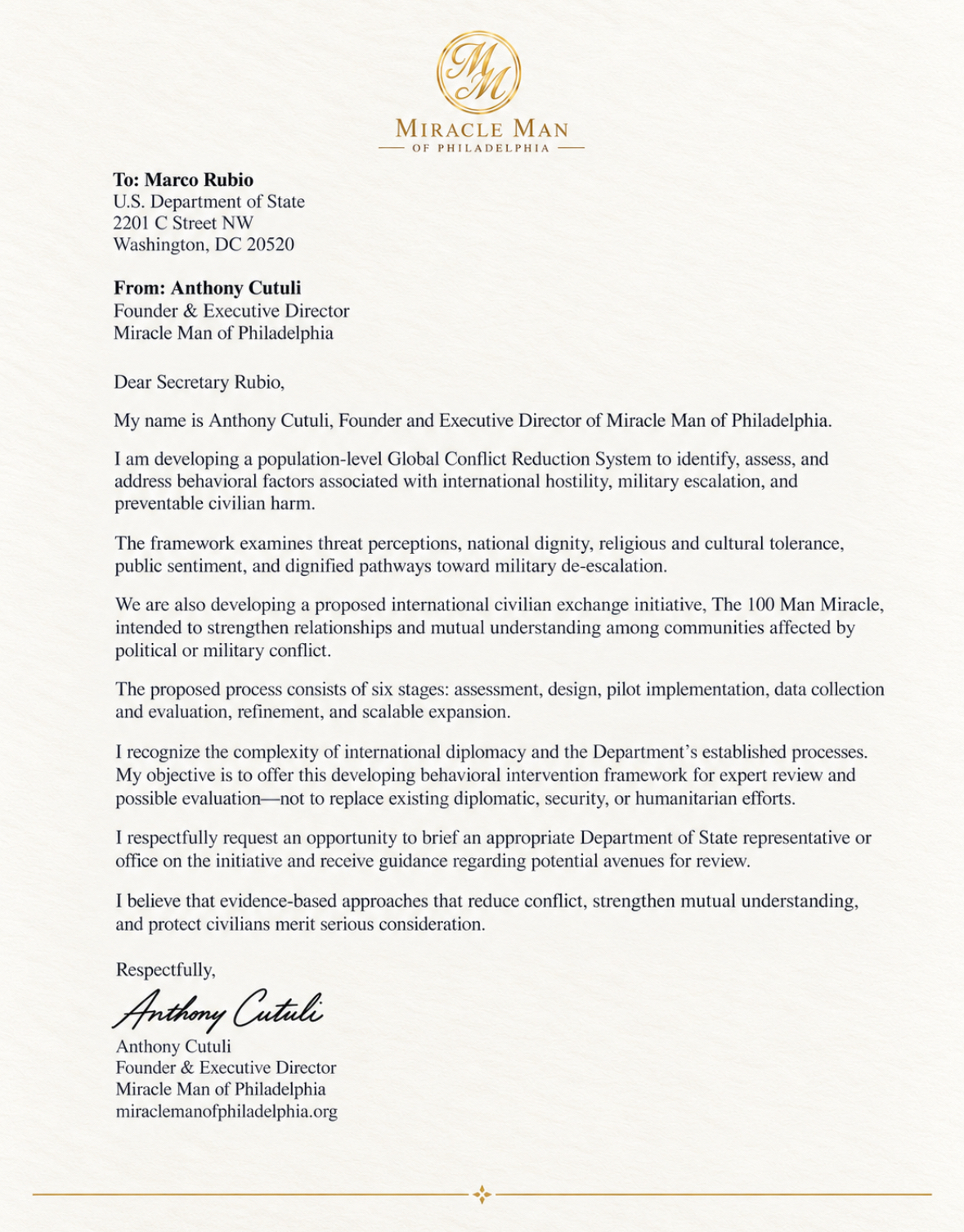
October 8, 2026 — Miracle Man of Philadelphia submitted a proposal to the U.S. Department of State requesting professional evaluation of its Global Conflict Reduction System.

View U.S. Department of State Letter  (HERE)

⸻


From Measurement to Impact

Measurement establishes the baseline and tracks change. Impact is confirmed when those changes are consistent, repeatable, and sustained across participants.

Real-World Deployment 


Pilot systems are actively being applied in real-world environments — including direct participant engagement, structured supervision, and field-based observation.


Early indicators of change are tracked through participant behavior, external reporting, and measurable performance indicators, providing a clear view of progress.

Scalable Impact


Once validated, these systems are designed for expansion across cities, states, and large-scale populations through coordinated partnerships and structured implementation.


The objective is not isolated success — but repeatable, scalable impact.

Impact Must Be Verified — Not Assumed 


Every system is built to produce measurable change. Results are tracked, evaluated, and refined before expansion and broader deployment.